

Configurations for Hydrofoil Boats
Understand why there are different configurations for the placement of hydrofoils on watercraft.
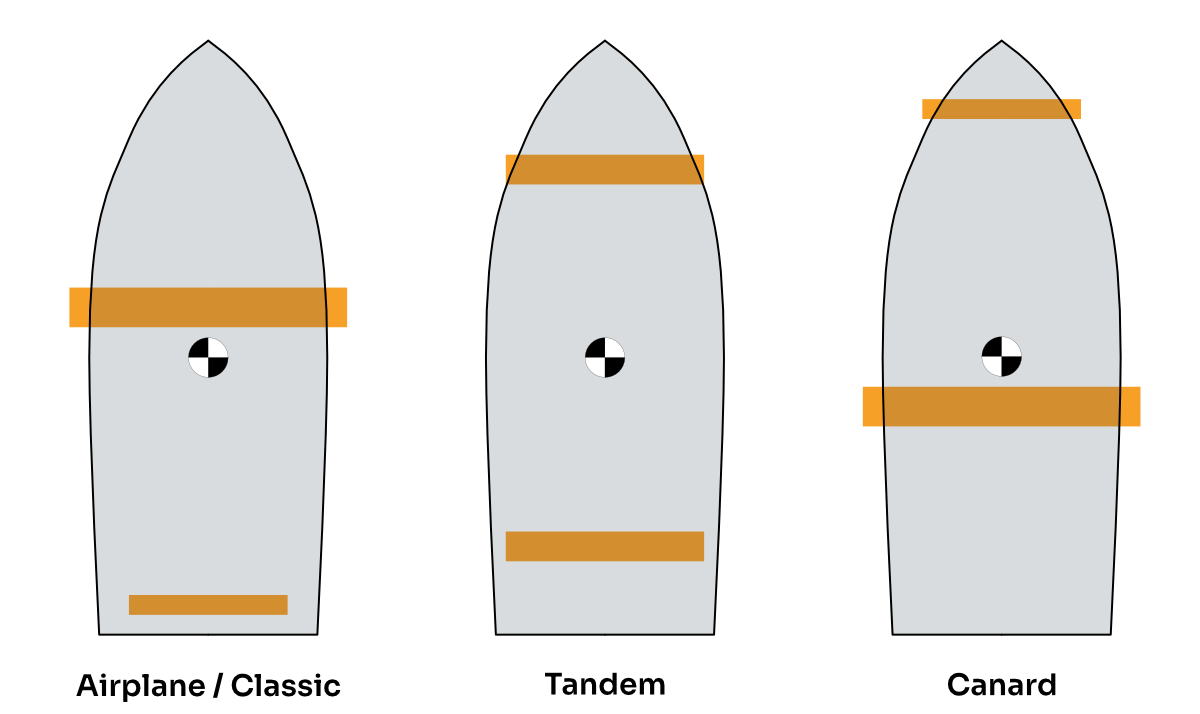
There are three primary configurations for the placement of foils (or wings) on hydrofoil vessels: the canard, tandem and aircraft arrangements.
1. Canard Configuration
In the canard configuration, the smaller set of hydrofoils (referred to as canards) is placed forward of the main foils, towards the front of the boat. This setup can be compared to the placement of small, forward wings on some aircraft. In hydrofoil applications, canard configurations may be preferred due to the matching of the physical shape of the hull and for hydrodynamic reasons.
An example of the canard configuration: the TU Delft Solar Boat 2016 has a canard configuration to enable a very efficient height control and steering system. These hydrofoils were designed and built by Flying Fish engineers. Another famous example is the Boeing Jetfoil design.
2. Tandem Configuration:
The tandem configuration involves two similar-sized hydrofoils positioned on the rear and front of the vessel. This setup distributes lift and weight almost equally between the front and rear foils. The advantage of this layout is that it potentially allows for better control, although it can be more structurally complex to design and implement.
An example of the tandem configuration: the Voskhod hydrofoils commonly use a tandem wing configuration. They were widely operated in the past, for example by the Fast Flying Ferry service between Amsterdam and Velsen in the Netherlands.
3. Aircraft Configuration:
The aircraft configuration places the larger main hydrofoils towards the front of the vessel, with smaller stabilizing foils at the stern, much like the layout of a conventional airplane. This setup may have advantages in terms of practical arrangment, because the smaller rear foil can be used for steering or propulsion with less exposure to floating objects in the water.
An example of the aircraft configuration can be seen in the TU Delft Hydro Motion Team’s hydrogen-powered boat. Supported by Flying Fish expertise, the team used an aircraft-style foil layout to make optimal use of the hull shape and weight distribution.
A crucial, related topic is the concept of flight stability and hydrofoil control.
Contact us
Thank you for your interest in Flying Fish. Feel free to reach out to us.
We're always open to answer your questions through a friendly conversation.


