

How a Hydrofoil Generates Lift
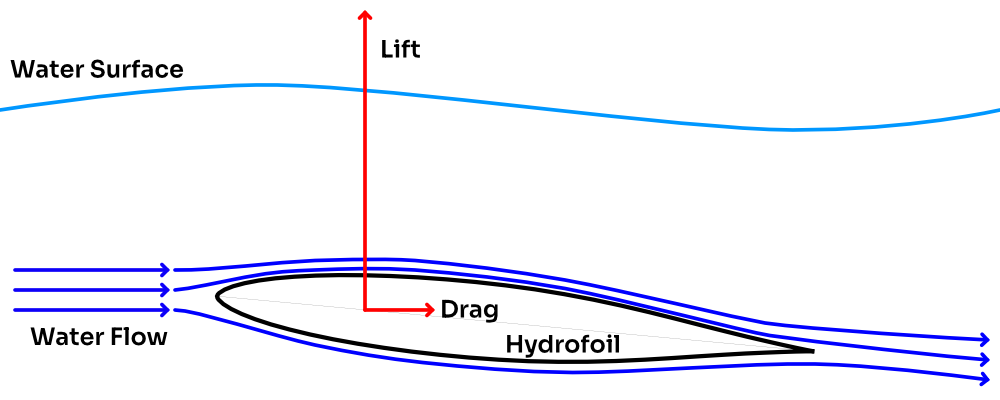
A hydrofoil creates lift by deflecting water downward. Its curved shape and the angle at which it moves through the water cause the water flow to deflect downward. As Newton proved that action equals reaction, the force required to deflect the water downwards causes lift force upward.
What Determines the Amount of Lift?
The lift generated by a hydrofoil depends on three main factors:
1. Foil Area
A larger foil generates more lift. If you double the surface area, you also double the lift.
2. Lift Coefficient
This relates to the foil’s shape and angle of attack (the angle at which it meets the water flow). Doubling the lift coefficient doubles the lift produced.
3. Speed Through Water
Lift increases with the square of the speed. Doubling the speed results in four times the lift.
4. The Free-Surface Effect
When a hydrofoil operates close to the water’s surface, the available lift is reduced. This is caused by the free-surface effect, where the proximity to the surface disrupts the flow around the foil and limits the pressure difference that can form. To achieve maximum lift, foils typically perform better when deeper below the surface.
Together, these factors determine how quickly a foil can raise a vessel out of the water and how efficiently it performs.
Why a Hydrofoil Experiences Drag
Drag is the resistance that a boat experiences moving through the water. The greater the drag force,the more energy you need to use to propel the boat forward. Hydrofoils experience up to 80% less drag than conventional fast vessels, but some drag is still remaining.
There a few different components that make up the total hydrofoil drag:
1. Form drag or Pressure drag
Form drag is drag due to the size and shape of a body. The more streamlined the body, the lower the pressure drag.
2. Friction drag or Viscous drag
This is drag due to the friction between a fluid and a surface. The fluid closest to the boat’s surface clings to it and moves as if attached to the surface.
3. Wave drag
Wave drag is the resistance from the waves that it creates itself by displacing water. This type of drag is bigger at higher speeds of the boat, and when the hydrofoil is closer to the surface.
4. Induced drag from vortex formation.
Lift induced drag occurs due to the pressure differences over the wing of hydrofoil. This pressure difference causes a whirling vortex at the wing tips, which costs energy. For a hydrofoil, there is also a vortex between the foil and the water surface. The closer the foil gets to the surface, the higher this surface induced drag.
Contact us
Thank you for your interest in Flying Fish. Feel free to reach out to us.
We're always open to answer your questions through a friendly conversation.


